A client of a friend of mine runs a packaging unit outside Pune. When he was setting up, his contractor pushed hard for a traditional RCC shed — "it's what everyone does," he was told. He went with PEB instead, mostly on a hunch, and ended up production-ready almost five months ahead of where he'd have been otherwise. That gap alone paid for a chunk of the building itself.
That's roughly the pitch for PEB in one story. But let's get into why it actually works out that way.
Time Isn't Free, Even If Nobody Puts a Number on It
Every extra month spent building is a month of rent, interest on loans, and salaries going out with nothing coming in. PEB shortens that window because a lot of the work — fabricating steel, cutting panels, prepping components — happens in a factory while your site team is still pouring foundations. By the time the ground work's done, the structure's often ready to go up.
Practically, that can mean opening in five or six months instead of over a year. For a business owner, that's not a minor convenience. It's revenue you'd have otherwise left on the table.
The Cost Math Actually Works in Your Favor
There's a common assumption that fast equals cheap-and-nasty. With PEB it tends to be the reverse, honestly. Factory fabrication means steel gets cut to precise specs with minimal waste, versus site work where mistakes and rework are just part of the deal. You also don't need as large a crew, or need them for as long.
Numbers vary by project, but a lot of business owners end up paying somewhere around 10-30% less than they would with conventional steel or RCC construction for similar-sized industrial space. That's money that stays in the business instead of the walls.
No Columns Getting in Your Way
PEBs can span long distances without internal support columns, which sounds like a small detail until you're trying to fit racking or machinery into a space and keep bumping into structural beams that shouldn't be there. Warehouses especially benefit — more usable floor, easier to plan layouts, less wasted square footage that you're still paying for.
Growth Doesn't Mean Starting Over
Businesses rarely stay the size they started at. Adding a bay, stretching a span, going up a level — all of that's a lot more manageable with a bolted steel structure than it is with concrete, where expansion usually means breaking into existing work and hoping it holds up. If there's even a chance you'll need more space in a few years (and there usually is), that flexibility matters more than people give it credit for.
Fewer Surprises Down the Road
Steel, properly coated and looked after, tends to age better than people expect — less susceptible to some of the issues concrete and brick deal with over the decades. It's not maintenance-free, nothing is, but the surprise repair bills tend to be smaller and less frequent.
So, Worth It or Not?
At the end of the day, a building's supposed to work for the business, not the other way around. PEB tends to deliver where it counts — you're in the building sooner, you spend less getting there, you actually use the space you're paying for, and you're not boxed in if things grow. That's really the whole reason it's gone from being a niche industrial option to something most owners in India at least seriously consider now.
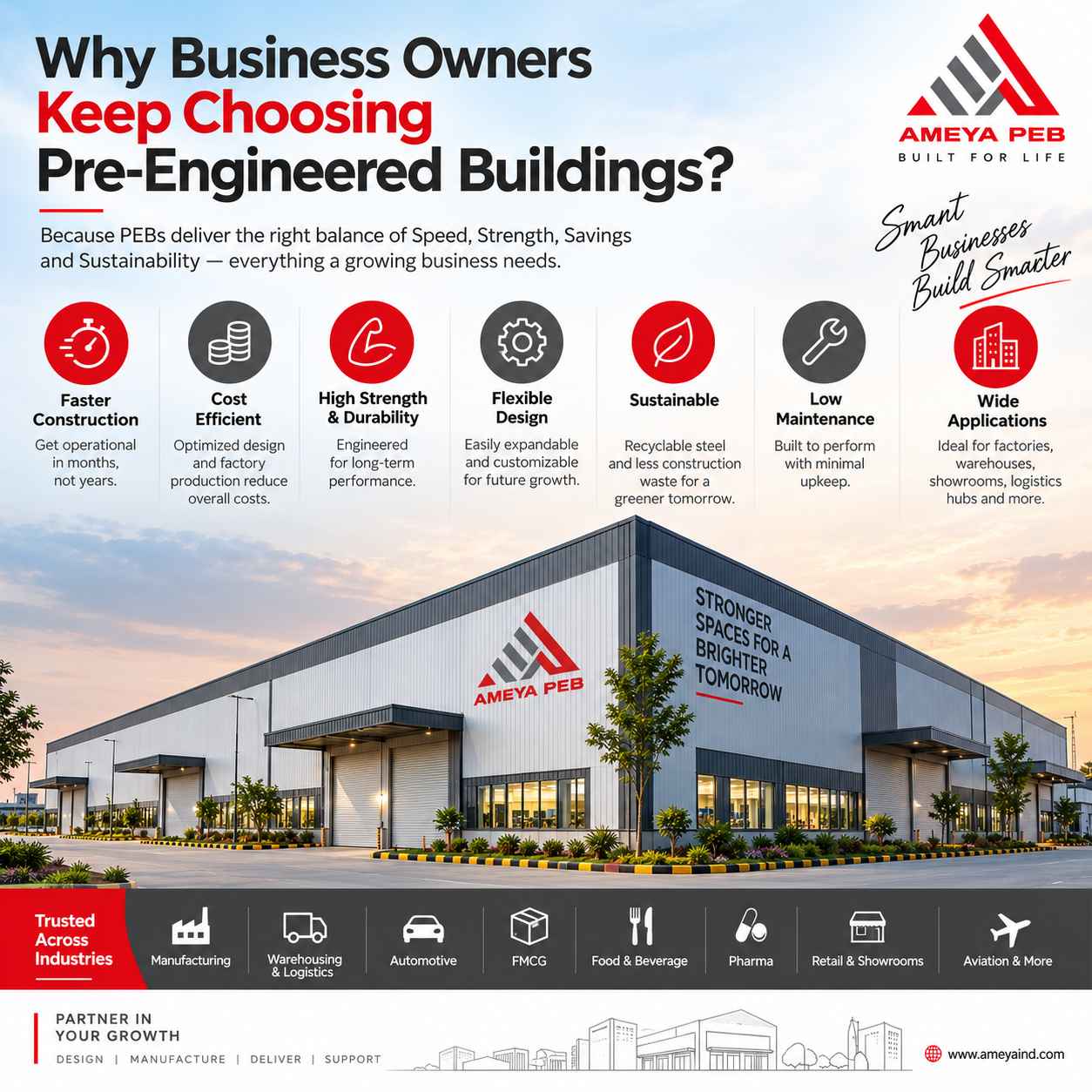
Why Business Owners Keep Choosing Pre-Engineered Buildings?
Frequently Asked Questions
Find quick answers to the most common questions related to Why Business Owners Keep Choosing Pre-Engineered Buildings?.
There's real math behind it — less material waste, smaller crews, shorter timelines. Most owners see somewhere in the 10-30% range in savings versus RCC or conventional steel, though it depends on the project size and site conditions.
Depends what you're building, but a mid-sized warehouse or factory shed that might take a year or more the traditional way can often be done in five to seven months with PEB. Bigger, more complex builds obviously take longer either way.
Yes, that's actually one of the bigger selling points. Adding bays or extending the structure is a lot less disruptive than trying to expand a concrete building, where you're usually cutting into existing work.
Not really. Modern PEBs can look just as polished as conventional buildings — plenty of showrooms and even office spaces use PEB now, not just industrial sheds. The finish depends more on what you spec than the construction method itself.
That's where it started, but it's spread well beyond that at this point — showrooms, gyms, schools, even multi-story offices in some cases. If your business needs a large clear-span space, it's worth at least considering.
Track record on similar projects, whether they do the structural design in-house or outsource it, and how they handle site coordination between fabrication and erection. A lot of the risk in PEB projects comes down to coordination, not the steel itself.
Need a Structural PEB Solution for Your Industrial Site?
Connect with our structural engineers today to map out a precise, cost-effective, high-speed warehouse or factory design.
Initiate Consultation