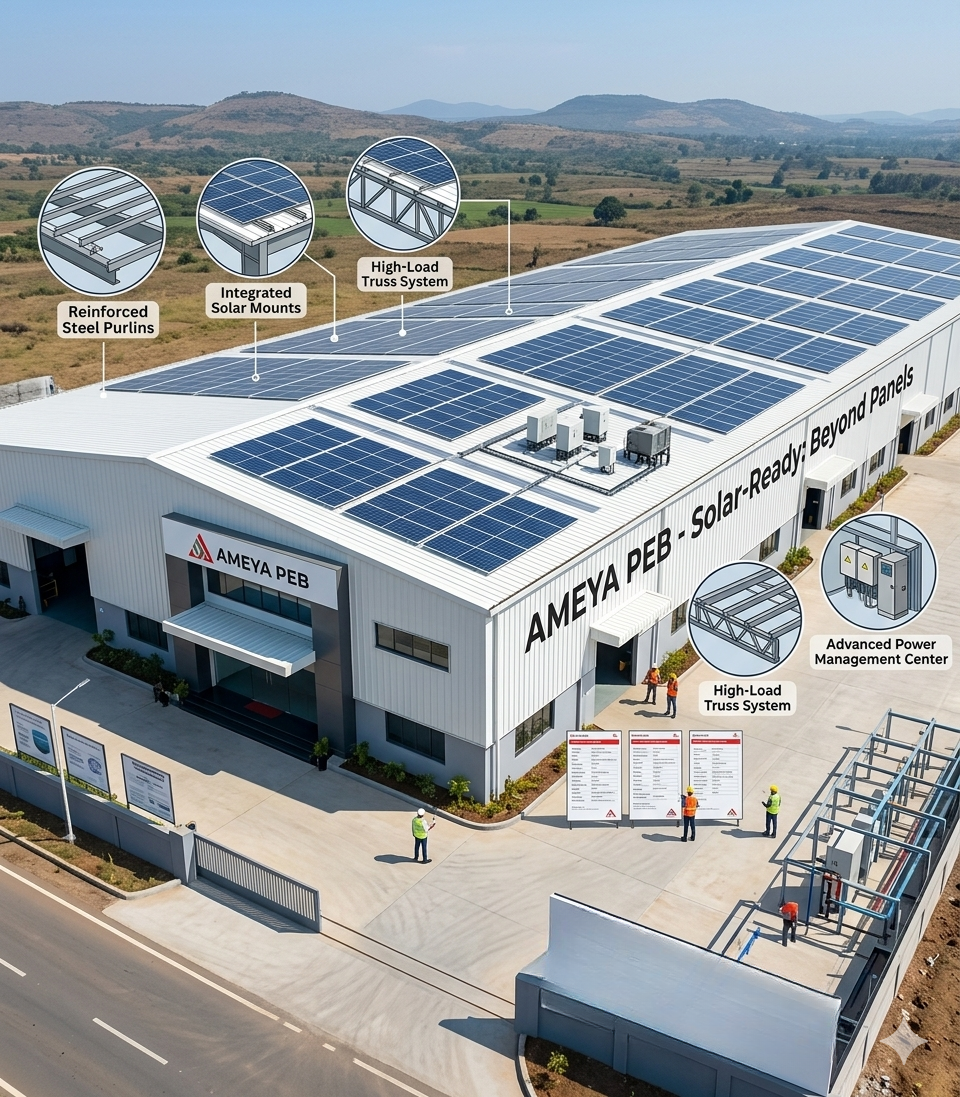
The Conversation Every Developer Is Having Right Now
You are sitting across from your structural consultant, reviewing the drawing package for a new 10,000 sq. m. warehouse in Pune or a logistics hub in Bhiwandi. Someone in the room says the words every developer now hears at least once before groundbreaking: “Should we make this solar-ready?”Your consultant nods. "Sure, we can add that." Two weeks later, the revised BOQ lands on your desk. The roof purlins have jumped a section, the rafter weight has climbed, foundation pad sizes have grown, and the total structure cost has gone up by 6–9%. You approved it because it sounded responsible.
But here is the question nobody asked: Were those upgrades actually engineered — or were they a blanket guess?
That gap between a guess and a calculation is where Ameya PEB operates. In this article, we walk through the structural engineering discipline of collateral load calculations for solar-ready PEB roofs: what they are, how they work, and how a rigorous approach lets you future-proof your building without paying for material you do not need today.
Solar-readiness is not a specification tick-box. It is a set of calculations that tell you exactly how much capacity to reserve, and where. — Ameya PEB Engineering Division |
Section 1: What “Solar-Ready” Actually Means Structurally
1.1 The Marketing Claim vs. the Engineering Reality
Most PEB vendors and most blog posts treat solar-readiness as a feature flag: a checkbox that either is or is not ticked. The language sounds reassuring — "our buildings are solar-ready" — but it communicates almost nothing about the underlying engineering.Structural solar-readiness means precisely one thing: the roof system has been designed to carry the dead load of a photovoltaic (PV) array that does not yet exist, without compromising the safety, serviceability, or economy of the building in its current state.
That definition has three moving parts, and each one requires calculation:
- The dead load of the future PV array (not a guess — a range derived from current panel specifications and mounting hardware weights)
- The structural capacity of the current roof system (purlins, rafters, connections, and foundations) expressed as available headroom above existing design loads
- The cost of reserving that headroom now versus the cost of retrofitting later
1.2 Why “We Can Always Add It Later” Is an Expensive Myth
Retrofitting a PEB roof for solar after construction is completed is not merely inconvenient — it is often economically irrational. Consider the cost layers involved in a post-construction solar upgrade on a standard PEB:
| Retrofit Cost Item | Typical Cost Range (INR) | Notes |
|---|---|---|
| Structural re-assessment & analysis | ₹1.5L – ₹4L | Per 10,000 sq. m. bay |
| Purlin replacement or sister-member addition | ₹18L – ₹60L | Depending on section jump |
| Additional rafter flange plates / haunches | ₹12L – ₹35L | Welding, NDT, painting included |
| Foundation underpinning (if columns overloaded) | ₹45L – ₹1.8Cr | Highly site-dependent |
| Interior operational disruption | Unquantifiable | Production loss, inventory relocation |
| Solar installation delay penalty | Project-specific | PPA and subsidy timing risk |
Compare that against the marginal cost of a properly calculated solar-ready design incorporated at the drawing stage: typically 1.5–3.5% of total structure cost for a standard span PEB. The math is not subtle.
Section 2: Point Loading — The Concept That Changes Everything
2.1 Distributed Load vs. Point Load: A Critical Distinction
When structural engineers first learned about building loads in college, they were introduced to the concept of uniformly distributed loads (UDL): a force spread evenly across a surface, like snow or rainwater ponding. Most building codes and standard PEB design tables assume this distribution for simplicity.Solar panels on a PEB roof do not create a uniformly distributed load.A rooftop PV array is mounted on a racking system — typically aluminium or galvanised steel rails — that transfers load to the roof through discrete attachment points. Those attachment points land on the purlins. Each attachment point is a concentrated, or point, load.This distinction matters enormously for purlin design. A purlin designed for a UDL of, say, 10 kg/m² may fail or deflect excessively if the same total load is delivered as two point loads at its third-points — even though the arithmetic total is identical. The bending moment diagram, shear force diagram, and deflection curve are fundamentally different.
| ENGINEERING INSIGHT: Why Point Load Math is Non-Negotiable |
| For a simply supported purlin of span L, carrying a UDL of w: |
| • Maximum bending moment = wL² / 8 |
| • Maximum deflection = 5wL⁴ / 384EI |
| For the same purlin carrying two equal point loads P at third-points (L/3 from each end): |
| • Maximum bending moment = PL / 3 |
| • Maximum deflection = 23PL³ / 648EI |
| If the total load is the same (2P = wL), the point load scenario produces a bending moment |
| that is 33% higher and a mid-span deflection that is 7–12% greater. |
| Designing without this correction is not conservative. It is incorrect. |
2.2 How a Solar Racking System Actually Loads Your Roof
Understanding the load path from panel to foundation is the foundation of every collateral load calculation. Here is how it works in a typical ballasted or penetrating-mount system on a PEB shed roof:
- Panel Weight: Each monocrystalline silicon panel (typically 72-cell, 400–500 Wp) weighs 20–25 kg. Bifacial glass-glass modules run heavier at 28–35 kg.
- Module Mounting Hardware: Rails, clamps, splice plates, and end clamps add another 3–6 kg per panel equivalent.
- Substructure/Purlin Clamp: The rail-to-purlin interface (hook bolt, purlin clamp, or through-bolt depending on sheet profile) creates the actual point load location.
- Rail Span: Racking rails typically span 1.0–2.0 m between purlin attachment points, creating a specific point load spacing relative to purlin span.
- Wind Uplift Contribution: Panels act as sails. In Cyclone Wind Zones III and IV (much of coastal India), the net upward wind pressure on the panel plus racking system can exceed the gravitational dead load, creating a net uplift point load on the purlin.
The combination of these five load inputs — modelled as point loads at specific locations along the purlin span — is what a proper collateral load calculation must capture.
Section 3: The Collateral Load Calculation Framework
Collateral load is the structural engineering term for the anticipated future dead load from building systems (HVAC, electrical conduit, conveyors, fire suppression, and yes, solar) that are not present at the time of initial construction but are anticipated within the building’s service life.Here is how a rigorous collateral load analysis for solar readiness is structured at Ameya PEB:
Step 1: Define the Solar Scenario
Before any calculation begins, the design team must establish a reference solar scenario. This is not a guess — it is a specification range based on current market data, projected technology trends, and the client’s likely energy ambitions.
| Parameter | Conservative Assumption | Moderate Assumption | Aggressive Assumption |
|---|---|---|---|
| Panel wattage | 400 Wp | 500 Wp | 600+ Wp (Tandem) |
| Panel weight | 22 kg (single glass) | 28 kg (bifacial) | 35 kg (glass-glass) |
| Coverage ratio | 60% of roof area | 75% of roof area | 90% of roof area |
| Dead load (panel + rack) | 8–10 kg/m² (gross) | 12–15 kg/m² (gross) | 18–22 kg/m² (gross) |
| Inverter/combiner boxes | Roof-mounted, 40–80 kg ea. | Roof-mounted, 80–120 kg ea. | Ground/wall mounted — roof nil |
For most industrial PEBs in India being designed today for a 2028–2032 solar installation horizon, the Moderate Assumption column is the appropriate starting point for collateral load reservation. This is consistent with the trajectory of panel efficiency improvements and the preference among EPC contractors for bifacial modules.
Step 2: Map the Load to the Purlin Grid
Purlins in a standard PEB shed are spaced 1.5 m to 2.0 m centre-to-centre along the rafter span, with secondary Z or C sections running perpendicular. The solar racking rail grid must be mapped against this purlin grid to determine attachment point locations.This mapping reveals:
- How many attachment points fall within each purlin’s span
- The eccentricity of point loads from the purlin’s quarter-points (critical for bending moment peaks)
- Whether any attachment points land on purlin mid-span (worst case for deflection) or near supports (best case)
- The tributary area of panels each purlin must support
Step 3: Run the Purlin-Level Point Load Analysis
With the load mapping complete, each purlin is analysed under its specific point load configuration. The analysis checks:
- Bending Capacity: Is the section modulus (Zxx) of the existing or proposed purlin sufficient to resist the combined dead load (self-weight + roofing sheet + collateral solar) expressed as moment?
- Shear Capacity: Are the web and flange-to-web welds adequate for the vertical shear at supports?
- Deflection Limit: Does the purlin deflect within L/150 to L/200 under point load combinations? (Excessive deflection can damage panel frames and void racking warranties.)
- Lateral-Torsional Buckling: For slender Z-purlins, does the addition of an eccentric point load from a rail clamp induce twisting that exceeds the unrestrained buckling moment?
- Connection Adequacy: Are the purlin-to-rafter cleats and bolt groups rated for the increased reaction forces?
Step 4: Check the Rafter and Frame
Purlin reactions from solar point loads are transferred to the primary frame (rafters, columns, and moment connections). The rafter-level check examines whether the existing or proposed primary frame sections have sufficient capacity to absorb the additional collateral load without:
- Exceeding the allowable stress or plastic moment capacity of the rafter
- Inducing additional horizontal thrust at eave level that the foundation cannot accommodate
- Causing sway or P-delta amplification that degrades the frame’s response to seismic loads (critical in IS 1893 Zones III, IV, and V)
Step 5: Foundation and Anchor Bolt Verification
The most expensive retrofit item is always the foundation. A solar array adds dead load, which increases column base reactions in compression — generally good for stability. However, in high-wind zones, the wind uplift component from panel sails can create net tension in anchor bolts, potentially exceeding the original design tension capacity.A proper solar-ready foundation design therefore includes an uplift check for the governing wind load combination per IS 875 Part 3 (2015), with the solar array modelled as a worst-case upward-loading surface in the appropriate wind pressure coefficient zone.
Section 4: Engineering the Headroom — Without Over-Spending
The natural instinct of any engineer asked to "future-proof" a structure is to increase everything. Heavier purlins. Deeper rafters. Larger columns. More concrete in the footing. This is safe — and wasteful.At Ameya PEB, our approach to solar-ready design is calibrated headroom: reserving precisely the structural capacity needed for the defined solar scenario, and no more. The techniques we use to achieve this without over-engineering include:
Technique 1: Phased Section Optimisation
Rather than jumping a purlin from, say, a Z-200 to a Z-250 (a full section increase), our engineering team first evaluates whether the existing section in a heavier grade of steel (Fe 550 instead of Fe 490) can carry the collateral load within the same profile depth. A section upgrade in material grade costs 4–8% more per tonne in material but avoids the purlin weight increase that cascades into rafter, connection, and foundation cost.
Technique 2: Strategic Attachment Point Location
If the solar racking system layout is coordinated with the purlin grid at the design stage (rather than left to the EPC contractor to figure out later), attachment points can be positioned at purlin quarter-points rather than mid-span. This reduces the governing bending moment by up to 25% compared to a mid-span point load, allowing a lighter purlin section to satisfy the collateral load check.This coordination costs nothing structurally. It simply requires the structural consultant and the solar EPC contractor to be in the same room during design development — a conversation Ameya PEB facilitates as part of its integrated project delivery model.
Technique 3: Conditional Reserve Capacity
Not every purlin in a shed carries the same loads. Purlins in the valley (low point) of a multi-gable structure carry more accumulated rainwater load. Purlins near eaves are subjected to higher wind uplift. Purlins in the building’s centre, away from wind and drainage effects, often have significant spare capacity under standard load combinations.A solar-ready design allocates the heaviest panel arrays over the structurally most efficient purlin zones and lighter arrays (or no panels) over the more heavily stressed zones. The solar layout is not arbitrary — it is structurally choreographed.
Technique 4: Haunch and Cleat Pre-Specification
The connection between purlin and rafter — the cleat — is a standard, low-cost component during fabrication. It becomes a costly, disruptive retrofit item post-construction. Solar-ready designs specify cleats with one additional bolt hole and a slightly larger seat (a marginal cost item at fabrication) to accommodate the increased purlin reaction from future solar loads without requiring any metalwork on site.
| COST BENCHMARKING: Solar-Ready Upgrade Costs at Design Stage |
| Based on Ameya PEB projects (2022–2025), 10,000 sq. m. industrial shed, standard span 30–40 m: |
| Material grade upgrade (Fe490 to Fe550, purlins only): +0.6–1.2% of structure cost |
| Purlin section jump (selected bays only): +0.8–1.8% of structure cost |
| Cleat and connection pre-specification: +0.2–0.4% of structure cost |
| Foundation uplift reinforcement (Wind Zone III+): +0.5–1.2% of structure cost |
| Engineering analysis and documentation: +0.3–0.6% of structure cost |
| TOTAL MARGINAL COST OF PROPER SOLAR READINESS: 1.5% to 5.2% of structure cost |
| Compare: Post-construction retrofit (same building): 14% to 35% of original structure cost |
Section 5: The LEED Connection — Why This Is Now a Certification Requirement
For developers pursuing LEED v4.1 BD+C certification — increasingly a requirement for MNC tenants, institutional investors, and green-labelled industrial parks — solar-readiness is not optional. LEED’s Renewable Energy category (EA Credit: Renewable Energy Production) awards points for on-site renewable energy generation, and its related credit EA Prerequisite: Minimum Energy Performance requires building systems to be modelled under ASHRAE 90.1.More directly relevant is the LEED v4.1 prerequisite and credit structure related to building envelope and structural longevity. The US Green Building Council’s guidance on solar-ready structures (aligned with the ASHRAE 189.1 Standard and the IgCC International Green Construction Code) recommends that buildings targeting LEED Gold or Platinum include:
- A structural assessment demonstrating that the roof can support a minimum 4 lb/ft² (approximately 20 kg/m²) of collateral dead load from PV equipment
- A conduit pathway from roof level to electrical room, sized for future PV wiring
- A roof area clear of HVAC equipment and other obstructions of not less than 40% of total roof area, designated for potential PV installation
- Documentation of the collateral load reserve capacity as part of the building’s as-built structural record
This last point is particularly important. LEED certification requires documentation. A vague assurance that the building is "solar-ready" will not satisfy a LEED reviewer. What will satisfy the reviewer is a structural engineering report that specifies, bay by bay, the available collateral load capacity in each roof zone, the point load assumptions used, and the sections and connections that have been specified to accommodate future solar installation.Ameya PEB prepares this documentation as a standard deliverable on all projects where LEED certification is a stated project goal. The report travels with the building’s record drawings and becomes a facility management asset when the solar EPC contractor arrives to install.
Section 6: A Worked Example — What the Numbers Actually Look Like
Let us walk through a simplified but realistic calculation scenario to make the abstractions concrete.
Project: 12,000 sq. m. Logistics Warehouse, Nagpur, Maharashtra
| Parameter | Value |
|---|---|
| Building Footprint | 200 m × 60 m |
| Roof Type | Single slope, 1:10 pitch, metal deck on Z-purlins |
| Purlin Span | 6.0 m (rafter to rafter) |
| Purlin Spacing | 1.5 m c/c |
| Current Purlin Section | Z-200 × 2.5 mm, Fe 490 |
| Wind Zone (IS 875:2015) | Zone II (Nagpur), Vb = 44 m/s |
| Seismic Zone (IS 1893) | Zone II (low seismic) |
| Target Solar Installation Year | 2028–2030 |
| Target Solar Capacity | 1,200 kWp (approximately 2,400 panels) |
Collateral Load Scenario (Moderate Assumption)
| Load Component | Load (kg/m² gross roof area) | Notes |
|---|---|---|
| Panel dead load (bifacial, 500 Wp) | 9.2 | 28 kg per panel ÷ 3.0 m² per panel |
| Racking/rail system | 3.5 | Aluminium extruded rail + hardware |
| Miscellaneous (conduit, wiring) | 0.5 | Allow per experience |
| TOTAL COLLATERAL DEAD LOAD | 13.2 | Applied over 75% coverage area |
| Effective load (100% roof area basis) | 9.9 | 13.2 × 0.75 |
Purlin Point Load Calculation (Per Purlin, Per Bay)
Tributary area per purlin (6.0 m span × 1.5 m spacing) = 9.0 m²
Collateral dead load per purlin = 9.9 kg/m² × 9.0 m² = 89.1 kg total
Solar rail spacing: 1.5 m, creating two attachment points per purlin span at 1.5 m and 4.5 m from support (i.e., quarter-points).
Point load at each attachment: 89.1 kg ÷ 2 = 44.6 kg (plus dynamic factor 1.1 = 49.0 kg per point load)
Applying the two-point-load bending moment formula:
M_solar = P × a = 49.0 kg × 9.81 N/kg × 1.5 m = 0.72 kN·m
Current Z-200 × 2.5 mm purlin (Fe 490) already carries:
- Self-weight moment: 0.18 kN·m
- Roofing sheet dead load moment: 0.42 kN·m
- Live load (maintenance) moment: 0.55 kN·m
- Wind uplift (net, governing combo): -0.31 kN·m (uplift)
Total governing moment with solar collateral = 0.18 + 0.42 + 0.55 + 0.72 = 1.87 kN·m
Section modulus of Z-200 × 2.5 mm = 33.2 cm³ = 33,200 mm³
Allowable bending stress, Fe 490: 0.66 × 490 = 323 N/mm²
Allowable moment = 323 N/mm² × 33,200 mm³ = 10.72 kN·m
RESULT: The current Z-200 × 2.5 mm section has a utilisation ratio of 1.87 / 10.72 = 17.4% under solar collateral load.
| KEY FINDING: No Section Upgrade Required for This Bay |
| The existing Z-200 × 2.5 mm, Fe 490 purlin has more than adequate bending capacity to absorb the |
| solar collateral load defined in this scenario. The combined utilisation ratio (all loads including solar) |
| remains below 65% of allowable, well within safe limits. |
| What IS required for solar-readiness in this bay: |
| • Cleat pre-specification: increase bolt hole count from 2 to 3 per cleat (marginal cost) |
| • Uplift check confirmation: net anchor bolt tension within original capacity |
| • Deflection documentation: L/214 under collateral — within L/150 limit |
| Total additional cost for this bay: approximately ₹1,200 per purlin in engineering and hardware. |
| Post-construction retrofit cost for the same bay: approximately ₹18,000–45,000 per purlin. |
Section 7: What to Ask Your PEB Vendor
Whether you are working with Ameya PEB or evaluating another supplier, here are the questions that separate genuine solar-ready engineering from marketing language:
- "Can you show me the collateral load calculation sheet for solar, bay by bay?" If the answer is "we’ve added 10 kg/m² across the whole roof," that is a UDL approximation, not a point load analysis. Ask again.
- "What solar scenario (coverage ratio, panel weight, wattage) did you use as your collateral load basis?" The answer should reference specific panel types, not a generic "future solar load."
- "How does the racking rail grid interact with your purlin spacing?" A vendor who has not thought about attachment point location has not done a real collateral load analysis.
- "Have you checked wind uplift on the panel array surface as well as panel dead load?" This is especially important in Cyclone Wind Zones III and IV.
- "What documentation will you provide for LEED or green building certification purposes?" Structural solar-ready certification requires a stamped engineering report, not a general statement.
At Ameya PEB, we welcome these questions. They are precisely the conversations our engineering team is equipped to have — and the discipline we apply to every project that carries a solar-readiness requirement.
Conclusion: The Difference Between a Checkbox and a Calculation
The Indian industrial real estate market is moving rapidly toward mandatory renewable energy integration. The Ministry of New and Renewable Energy’s Pradhan Mantri Kisan Urja Suraksha evam Utthaan Mahabhiyan (PM-KUSUM) and the Bureau of Energy Efficiency’s Energy Conservation Building Code (ECBC) Commercial are both pushing industrial rooftops into the solar mainstream. LEED, IGBC Green Factory, and WELL certifications are adding structural documentation requirements on top.In this environment, the phrase "our buildings are solar-ready" is rapidly becoming as meaningless as "our buildings are structurally sound." What matters is the calculation behind the claim.Collateral load calculations for solar-ready PEB roofs are not exotic engineering. They are disciplined, methodical, and when done correctly, they save developers significant capital — both today (by avoiding over-design) and tomorrow (by eliminating costly retrofits).
Ameya PEB brings this discipline to every project. If you are planning an industrial, warehousing, or commercial PEB with a solar horizon, we invite you to begin the conversation at the drawing board — not at the retrofit invoice.
The best time to design for solar was when you designed the building. The second best time is right now, before fabrication begins. — Ameya PEB — Engineering Division |