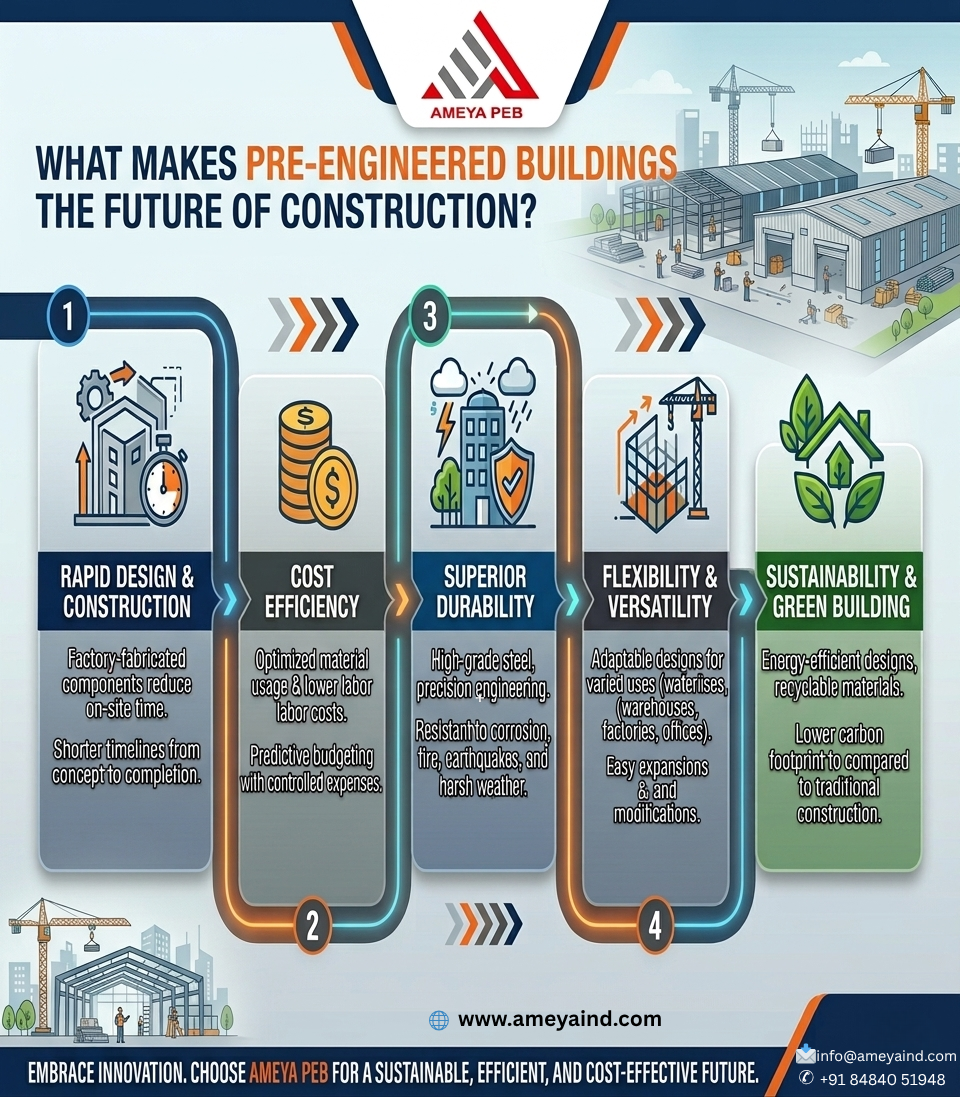
What Makes Pre-Engineered Buildings the Future of Construction?
40% Faster construction vs. conventional | 30% Reduction in overall project costs | 90% Of steel components are recyclable |
The construction industry is at a crossroads. Deadlines tighten, budgets shrink, and the pressure to build faster, greener, and smarter has never been greater. Pre-engineered buildings (PEBs) aren’t just a trend — they’re becoming the structural backbone of modern infrastructure, from logistics hubs to schools, factories to sports arenas.
So, What Exactly Is a Pre-Engineered Building?
A pre-engineered building (PEB) is a structure where all components — primary steel frames, secondary members, roofing, cladding, and connections — are designed, fabricated, and supplied by a single manufacturer, then assembled on-site like a precision kit.
Unlike conventional construction where materials are ordered separately and assembled by multiple contractors, PEBs are engineered as a complete system. Every bolt hole, every purlin, every bracket — all pre-calculated to work in harmony. The result is a building that’s not only structurally superior but dramatically more efficient to erect.
Seven Reasons PEBs Are Reshaping the Industry
⚡ Speed to Completion
Factory fabrication runs in parallel with site preparation. What takes months with brick-and-mortar can be achieved in weeks with PEB.
💰 Cost Predictability
Single-source manufacturing eliminates material waste and coordination overruns. Budgets stay tight because scope is locked in at design stage.
🌿 Sustainability Built In
Steel is the world’s most recycled material. PEBs generate minimal on-site waste, consume less energy, and can be dismantled and relocated.
📐 Design Flexibility
Contrary to the “steel box” stereotype, PEBs accommodate complex geometries, wide clear spans, mezzanines, facades, and mixed aesthetics.
🔩 Structural Precision
Computer-aided engineering ensures every component meets exact tolerances — reducing errors, rework, and structural risk.
🔧 Low Maintenance
Galvanized and coated steel resists corrosion, pests, and rot. Long-term ownership costs are significantly lower than conventional builds.
| “The global pre-engineered buildings market is projected to exceed $32 billion by 2030, driven by rising demand in e-commerce warehousing, cold-chain logistics, renewable energy infrastructure, and affordable commercial construction across emerging markets.” |
PEB vs. Conventional Construction: A Direct Comparison
The differences aren’t marginal — they’re structural to how modern projects are delivered.
| Factor | Pre-Engineered Building | Conventional Construction |
| Design-to-delivery | 8–14 weeks | 6–18 months |
| Material waste | Minimal (factory cut) | 10–15% typical waste |
| Design changes mid-build | Moderate flexibility | High flexibility |
| Future expansion | Designed for it | Difficult and costly |
| Foundation requirement | Lighter (optimized loads) | Heavier, more material |
| Quality control | Factory-controlled | Site-dependent |
Where PEBs Are Already Winning
The versatility of pre-engineered construction means it’s not confined to any single sector. Here’s where the technology is already proving itself at scale:
- Warehousing & Logistics — E-commerce giants use PEB warehouses because they deliver massive clear spans (60m+), rapid deployment, and seamless scalability as operations grow.
- Manufacturing Facilities — Heavy equipment manufacturers benefit from column-free interiors that allow overhead cranes, large machinery, and flexible floor layouts.
- Aviation Hangars — Aircraft hangars demand massive, unobstructed spans. PEB technology delivers structures up to 90m wide without intermediate supports.
- Cold Chain & Food Processing — Tight temperature control requires precise insulation integration — something factory-engineered PEB panels handle better than site-built alternatives.
- Renewable Energy Infrastructure — Solar panel support structures, wind turbine maintenance facilities, and power substations increasingly rely on PEB for fast, reliable, low-maintenance enclosures.
The Technology Powering Modern PEBs
Today’s pre-engineered buildings aren’t built on drawing boards — they’re born in software. Advanced structural analysis programs (like STAAD.Pro and ETABS) optimize every member for load, seismic zone, wind speed, and thermal expansion before a single piece of steel is cut.
BIM (Building Information Modelling) integration allows architects, engineers, and clients to walk through a virtual version of the structure before fabrication begins — catching clashes, validating aesthetics, and streamlining approvals. The digital twin becomes the build manual.
On the fabrication floor, CNC-controlled cutting and drilling produces components to ±0.5mm accuracy. Robotic welding lines ensure consistent weld quality across thousands of joints. What once required weeks of skilled on-site labour is now executed in days inside a controlled factory environment.
What the Critics Get Wrong
The most common objection to PEBs is aesthetic: “they look like sheds.” This was fair criticism in the 1980s. It isn’t anymore. Modern PEBs incorporate glass facades, architectural cladding, composite panels, brick accents, and complex rooflines that make them indistinguishable from conventionally built structures at street level.
The second objection is that PEBs lack flexibility mid-project. True — once fabrication begins, major changes carry cost implications. But this is by design: the upfront engineering investment is precisely what eliminates costly surprises downstream. The discipline forced at the design stage is a feature, not a bug.
The Road Ahead: PEBs and the Net-Zero Imperative
Construction accounts for roughly 38% of global carbon emissions. As governments enforce stricter embodied-carbon targets, the industry faces a reckoning. Pre-engineered buildings offer a structural pathway to compliance: optimized steel usage reduces embodied carbon, factory production reduces transport and waste emissions, and PEB structures are designed from day one for eventual disassembly and material recovery.
The next generation of PEBs will integrate low-carbon steel (produced via electric arc furnaces or green hydrogen), solar-ready roofing systems, and smart building sensors embedded at the fabrication stage — not bolted on as afterthoughts. The convergence of precision manufacturing, digital engineering, and sustainable materials is making PEB not just practical, but inevitable.