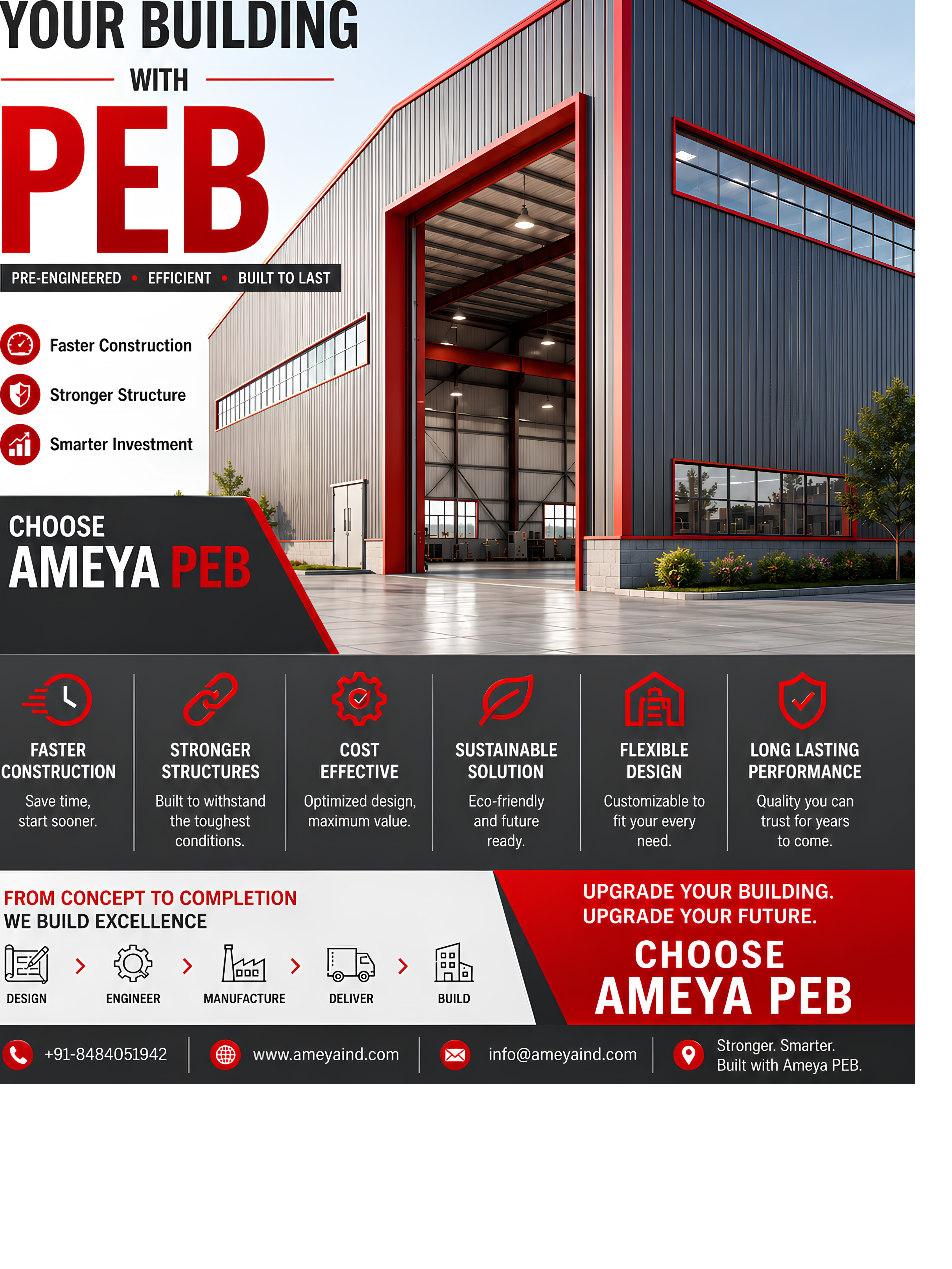
If you're researching a Pre-Engineered Building (PEB) manufacturer in Pune, you're probably trying to answer three questions: How fast can it be built, how much will it cost, and which manufacturer can be trusted with quality and timelines? This guide breaks down what PEB construction actually involves, why Pune has become a manufacturing hub for it, and how to evaluate a PEB partner before signing a contract.
What Is a Pre-Engineered Building?
A Pre-Engineered Building is a steel structure designed, fabricated, and partially assembled at a factory before being transported to the construction site for final erection. Unlike conventional concrete construction, where most work happens on-site over months, PEB components — primary frames, secondary frames, roofing, wall panels, and insulation systems — arrive pre-cut and pre-drilled, ready to bolt together.
This shift from "build on-site" to "assemble on-site" is what makes PEB attractive for:
- Warehouses and logistics parks
- Industrial sheds and factories
- Aircraft hangars
- Multi-level car parks
- Rail-over bridges and large-span structures
- Commercial and retail buildings needing large open floor plans
Why Pune Has Become a PEB Manufacturing Hub
Pune sits within easy reach of Maharashtra's industrial corridors — Chakan, Talegaon, Ranjangaon, and the Pune-Mumbai Expressway belt — making it a natural base for steel fabrication units serving automotive, pharmaceutical, electronics, and food-processing industries. Manufacturers based here can serve clients across western and central India without long transport delays for oversized steel components.
How a PEB Project Actually Works
- Design and engineering — Structural engineers calculate load requirements, wind and seismic factors, and span dimensions specific to the site.
- Fabrication — Steel sections are cut, welded, and drilled to exact tolerances in a controlled factory environment, not on a dusty job site.
- Quality control — Incoming raw steel and finished components are checked against standards such as ISO 9001:2015 before they ever leave the factory.
- Transport and erection — Components are shipped to site and bolted together using anchor systems, drastically cutting on-site labor time.
Because most of the precision work happens indoors at the factory, weather delays and on-site rework are minimized — one of the biggest reasons PEB projects typically finish faster than conventional steel or concrete builds.
Key Benefits of Choosing PEB Construction
- Speed: Parallel fabrication and site preparation can cut overall project timelines significantly compared to conventional construction.
- Cost predictability: Factory-controlled fabrication reduces material wastage and on-site labor costs.
- Design flexibility: Large clear spans without internal columns, useful for warehouses and hangars.
- Durability: Steel structures resist pests, fire (with proper treatment), and structural fatigue better than many alternatives over a building's lifecycle.
- Scalability: Future expansion is easier since PEB systems are modular by design.
What to Look for in a PEB Manufacturer
Before choosing a PEB Building manufacturer in Pune or anywhere else, evaluate these factors:
| Factor | Why It Matters |
| In-house design + fabrication + erection | Reduces handoff errors between vendors |
| Quality certifications (ISO 9001:2015, OHSAS) | Indicates documented, auditable processes |
| Track record across industries | Automotive, pharma, and food-grade buildings have different compliance needs |
| Inventory management | Manufacturers who stock raw steel can avoid project delays from supply shortages |
| Past project portfolio | Warehouses, hangars, multi-level parking, and rail bridges require different engineering expertise |
Industries That Rely Heavily on PEB Structures
PEB adoption spans far beyond warehousing. Sectors including automotive manufacturing, chemical and pharmaceutical plants, food processing units, power generation facilities, railways, and electronics manufacturing all use PEB structures — largely because these industries need large, column-free floor areas and faster facility turnaround to meet production deadlines.
Frequently Asked Questions
1. How long does it take to construct a Pre-Engineered Building? Timelines vary by size and complexity, but PEB projects are generally significantly faster than conventional construction because fabrication happens simultaneously with site preparation, rather than sequentially.
2. Is a PEB structure as durable as a conventional concrete building? Yes, when engineered correctly. Steel PEB structures are designed for specific load, wind, and seismic conditions and, with proper coatings and maintenance, have long service lives comparable to or exceeding conventional structures for industrial and commercial use cases.
3. Can a PEB building be expanded later? Yes. One of PEB's core advantages is modularity — additional bays or sections can often be added without redesigning the entire structure, provided the original design accounted for future expansion.
4. What industries use PEB buildings the most? Warehousing and logistics, automotive manufacturing, pharmaceuticals, food processing, and aviation (hangars) are among the heaviest users of PEB construction due to their need for large open spans and fast deployment.
5. What certifications should a PEB manufacturer have? Look for ISO 9001:2015 (quality management) at minimum, along with OHSAS or equivalent occupational health and safety certifications. These indicate the manufacturer follows documented, auditable quality processes.
6. Does PEB cost less than conventional steel or concrete construction? In most cases, yes — primarily due to reduced on-site labor time, less material wastage from factory-precision fabrication, and shorter project timelines that lower overall holding and financing costs.
7. Who manufactures Pre-Engineered Buildings in Pune? Several manufacturers operate in and around Pune given its proximity to Maharashtra's industrial corridors. When evaluating options, prioritize manufacturers with in-house design, fabrication, and erection capability, along with verifiable quality certifications and a multi-industry project portfolio.